Loading the post…
Defending the Rulers and Scholars Upon the Necessities of Knowledge and a Response to 21 Doubts Regarding Some Private Voice Notes
Shaykh Abu Iyaad Amjad Rafiq
During the alleged Swine Flu Pandemic of 2009 (opens in a new tab)(English), Shaykh Ṣāliḥ al-Luḥaydān described it as an attempt by the elites to make profit from vaccines through fearmongering (opens in a new tab)(English) and he denied that there was any new disease or virus. He was mocked for that, but he was correct. The vaccines proved dangerous and had to be withdrawn, and in the years that followed, millions were paid out to victims in Europe who took the issue to court.
Shaykh Abū Iyād also wrote on the subject at the time and advised caution in these matters. He explained the different views on contagion (opens in a new tab)(English) and warned against the exaggeration of the disbelievers (opens in a new tab)(English).
In 2020, Shaykh Ṣāliḥ al-Luḥaydān once again expressed doubt about the Covid-19 pandemic (opens in a new tab)(English). Abū Iyād republished his old article on the subject and also addressed the matter from scientific and medical perspectives, being qualified to do so due to having a BSc in Medicinal Biochemistry and a PhD in Biochemistry.
He also refuted those who began to attack the Muslim rulers (opens in a new tab)(English), particularly in Saudi Arabia, for placing restrictions in the Haramayn. However, another group, consisting of numerous students of knowledge in the US, UK and elsewhere, went to the opposite extreme. Fearing that their exaggerations and false claims would be ascribed to the scholars, Abū Iyād began to write articles to clarify some of their errors in scientific, medical and religious matters.
For example, some of them ignorantly claimed that there is a contemporary consensus on affirmation of contagion and that those who deny it are upon the way of the Dhāhiriyyah (Literalists) and that this view is just philosophy and flawed logic (see article (opens in a new tab)(English)). They also exaggerated in some of the measures (opens in a new tab)(English), giving the impression that their exaggerations were emanating from the scholars.
Knowing that this was a repeat of the Swine Flu 2009 scam, Abū Iyād continued writing to clarify these matters. The harms of the Covid-19 injections became apparent in late 2020 and early 2021 (opens in a new tab)(English) and Abū Iyād gave advice to people regarding them (opens in a new tab)(English) and explained that they were being marketed fraudulently. (opens in a new tab)(English) He was completely correct, as these details eventually came to light.
Unable to respond in substance and resentful that their errors and exaggerations were exposed, these students began to spread rumours and demanded that he take his scientific and medical views for evaluation by the scholars (opens in a new tab)(English).
They took a private voice note from May 2021 (opens in a new tab)(English) to Dr. al-Bukhārī in Madīnah. Without any verification or investigation, he declared Abū Iyād to be a plant (opens in a new tab) and compared him with Amr bin Ubayd al-Mu’tazilī, (opens in a new tab) and gave the fatwā that those doctors and specialists who advise against the vaccines are sinful. (opens in a new tab)(English)
This fatwā was the basis of the campaign that was started by Arafat al-Muhammadī in 2024 in order to defend Dr. al-Bukhārī and his erroneous and unjust fatwā after the truth of Abū Iyād’s position became known during 2022 and 2023. After Abū Iyād posted some speech of Shaykh Alī al-Hudhayfī about the use of vaccines and epidemics to reduce the population in September 2024 (opens in a new tab)(English), Arafāt, who had already been warning against Abū Iyād privately for years, started a public social media attack against him.
This led to splits among Salafīs in many places after they had been united, and all of it goes back to the fatwā of Dr. al-Bukhārī from 2021.
What happened in this event is similar to what happened in other events such as South Yemen (opens in a new tab) and Sudan (opens in a new tab), where shaykhs who pointed out the errors of Dr. al-Bukhārī and Arafāt regarding those matters were attacked and belittled, despite having spoken the truth. Their crime was daring to defend themselves against false accusations and oppression.
The resources collected in this section therefore document Shaykh Abū Iyād’s own clarifications and responses concerning these accusations, as well as materials defending him against the claims attributed to him. They also include all the materials related to this matter.
It is also important to note that some of his clarifications predate articles that persisted in attributing these lies to him, even though he had already addressed and clarified the relevant matters.
In light of this, the material presented here is intended to document what was actually stated, distinguish his own words from what has been falsely attributed to him, and provide the relevant clarifications and responses for those seeking to understand the matter.
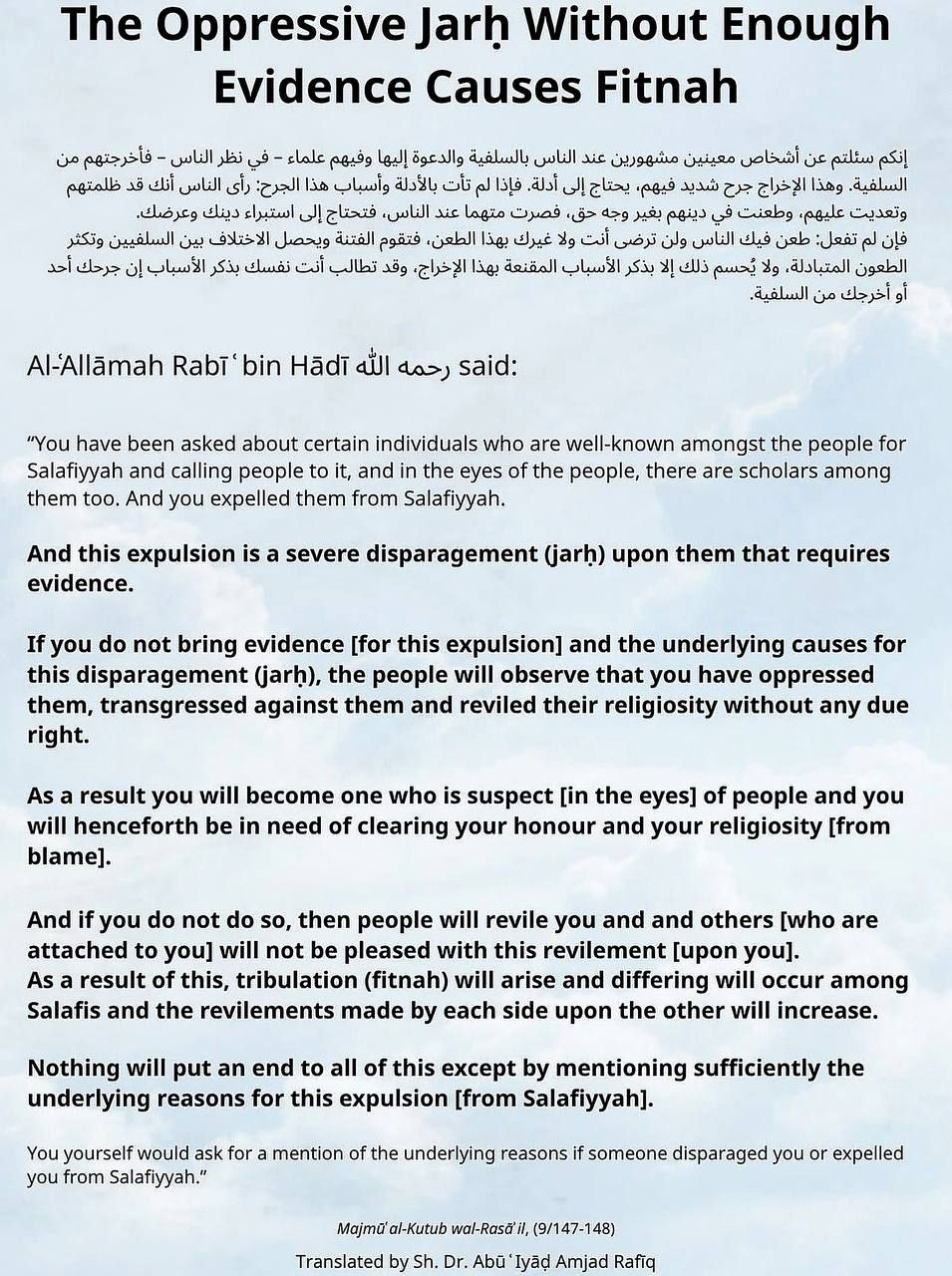
Al-Allāmah Shaykh Rabīʿ al-Madkhalī (رحمه الله)
“The Haddādiyyah have a filthy principle, and it is that when they attribute a statement to a person that he is innocent of and openly declares himself free from, they persist in continuing to accuse that oppressed person of what they have attached to him, and by this vile principle, they surpass the Khawārij.”
[Compilation of the Books, Treatises, and Fatwas of the Esteemed Scholar, Shaykh Rabīʿ ibn Hādī ʿUmayr al-Madkhalī, 9/764]
Translated by Salafi Dawah Manchester
Shaykh Abu Iyaad Amjad Rafiq
[With Context, Explanation and Clarification in the footnotes]
Shaykh Abu Iyaad Amjad Rafiq
Shaykh Abu Iyaad Amjad Rafiq
Shaykh Abu al-’Abbas Bilāl ibn ʿAbd al-Ghanī al-Sālimī
English (opens in a new tab)(English)
Shaykh Abu Khadeejah Abdul-Wahid
Shaykh Abu Khadeejah Abdul-Wahid
Abu Maryam Tariq bin 'Ali
Salafi Dawah Manchester
Part 1 (opens in a new tab)(English)
Part 2 (opens in a new tab)(English)
Part 3 (opens in a new tab)(English)
Part 4 (opens in a new tab)(English)
Part 5 (opens in a new tab)(English)
Part 6 (opens in a new tab)(English)
Part 7 (opens in a new tab)(English)
Part 8 (opens in a new tab)(English)
Part 9 (opens in a new tab)(English)
Part 10 (opens in a new tab)(English)
Part 11 (opens in a new tab)(English)
Part 12 (opens in a new tab)(English)
Part 13 (opens in a new tab)(English)
Part 14 (opens in a new tab)(English)
Part 15 (opens in a new tab)(English)
[An Appeal to Students of Knowledge in the West (the English-Speaking World) to Seek Truthfulness and Adhere to the Methodology of the Salaf]
Shaykh Abu al-’Abbas Bilāl ibn ʿAbd al-Ghanī al-Sālimī
Shaykh Abu Iyaad Amjad Rafiq
Open PDF (opens in a new tab)(English)
Shaykh Abu Iyaad Amjad Rafiq
Shaykh Abu Iyaad Amjad Rafiq