Welcome, and may Allah greet you well, my brother.
Regarding your question about this phrase: “Do not interfere between the mashayikh”, or “Leave matters involving dispute or disagreement among the mashayikh”, this statement, when taken absolutely without qualification, is open to scrutiny.
If the issues circulating among scholars or people of knowledge are matters that cannot be fully grasped by everyone in the field of seeking and acquiring knowledge—requiring instead senior scholars who possess the necessary scholarly depth and qualifications, and involving ijtihad and scholarly exchange—then undoubtedly, it is not permissible to interfere in these matters.
They are more knowledgeable and better informed, possessing qualifications not found in those of a lower rank, whether they be beginner or intermediate students of knowledge, or the general public.
In this context, the statement holds true, supported by the authentic Sunnah: “Part of the perfection of a person’s Islam is leaving alone that which does not concern him.” Scholars often discuss contemporary jurisprudential issues that require ijtihad and careful examination to arrive at a Shari’ah ruling or a jurisprudential opinion; in this regard, the statement is valid.
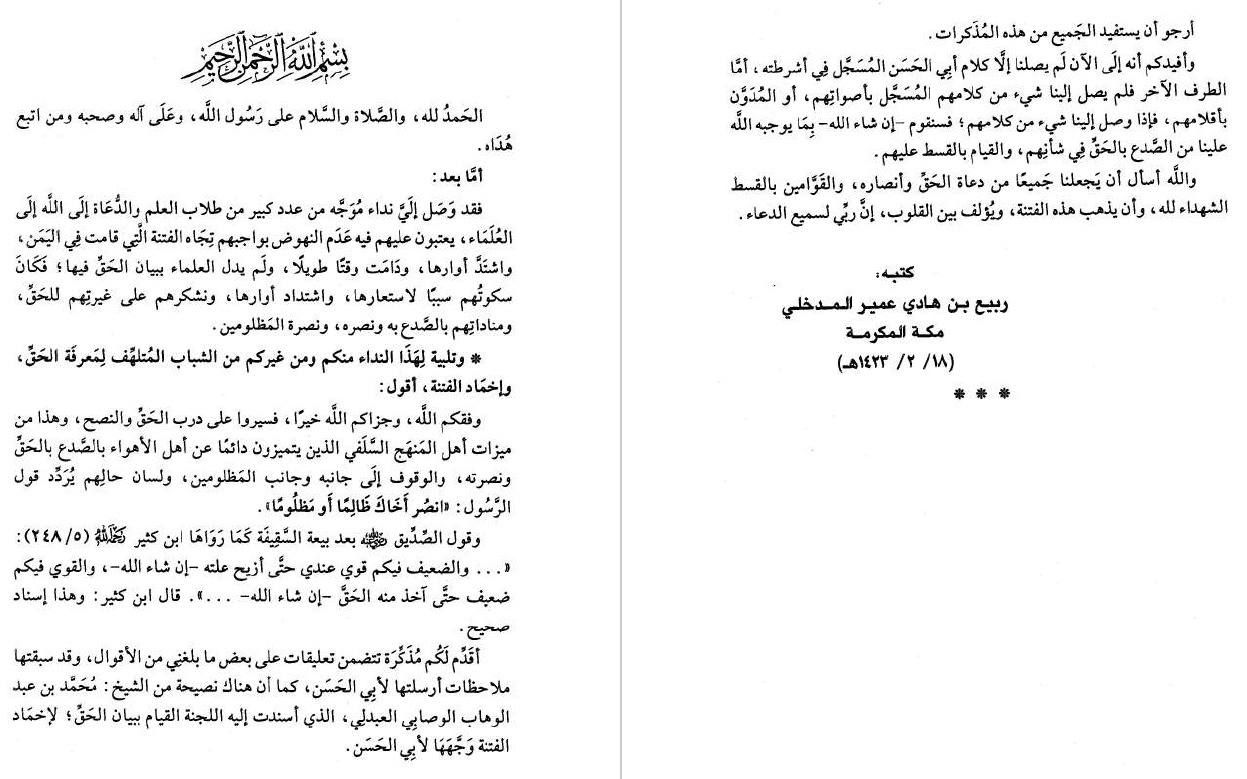
However, if the issues currently present in the arena are matters of methodology (manhaj) or creed (‘aqidah)—where truth is opposed by falsehood, and there are divisions between parties, yet the truth is undoubtedly clear, supported by Shari’ah evidence and the established stance of scholars—then it is obligatory to champion the truth and its proponents.
Students must be advised to follow the truth and what is correct, and to support that truth and those who uphold it. This is the obligation.
The controversial issues present today are significant matters that have already been settled by Allah’s law; they have been resolved by our scholars and studied by Salafis and students alike. These principles are fundamental and clearly established in the Book of Allah, the Sunnah of His Messenger (صلى الله عليه وسلم), and scholarly texts.
They include matters such as hearing and obeying those in authority and not rebelling against them; fighting the Kharijites alongside the rulers; standing with Muslim armies against aggressors, Kharijites, and rebels; and upholding truthfulness, adopting it as a motto, a way of life, a call to others, and a standard of discourse.
These are clear matters; whoever contradicts them should be counseled. If they do not heed the counsel, they should be shunned, and others should be warned against them. Scholars active in the field ought to address these issues and guide students of knowledge to adhere to them in accordance with Shari’ah, to hold fast to them, and to support both these principles and those who uphold them. This is the reality of the situation today.
However, if we tell students, ‘Remain silent, do not speak, do not follow, and do not get involved,” deviation will inevitably occur. Students who harbour a good opinion of their sheikh or teacher will be left in a state of total blindness, misled and confused, because their teacher failed to clarify the truth and the correct path, or to distinguish between those who are right and those who are wrong.
Consequently, they will find themselves adrift in a sea of bewilderment, chaos, and loss. True counsel to students of knowledge involves telling them: ‘This is the truth, so adhere to it; these people have upheld it, so stand with them—not out of personal attachment, but because they have spoken the truth. Conversely, those others have contradicted the truth and are upon falsehood, error, and deviation, so beware of them, stay away from them, and avoid their path.’
This is the counsel due to every Muslim, let alone students of knowledge who seek the pleasure of Allah and the pursuit of knowledge. Why do they acquire this knowledge? To distinguish truth from falsehood, to follow the truth, and to abandon falsehood.
When we issue such statements [discouraging engagement], we only exacerbate strife and confusion, and we raise a generation that is lost, wandering aimlessly, unable to distinguish between truth and falsehood. We would remain silent regarding the support of the truth and its adherents, and remain quiet, Allāh forbid, at times when we ought to speak, guide, and instruct.
Therefore, voicing such a statement in a context marked by disagreement over fundamental principles of methodology and creed—and by a conflict between two factions, one calling for the truth and adherence to the legitimate foundations and established tenets of Islam, and another opposing all of this—requires us to champion the truth and its people. We must avoid expressions that cause confusion or leave students feeling lost, lacking in resolve, and misled.
Everyone here must support the truth and its adherents, and aid the oppressed—just as the Prophet (صلى الله عليه وسلم) said: “Aid your brother, whether he is an oppressor or oppressed.” We must not be among those who discourage or abandon the cause, nor among those who oppose the truth and its people.
Consequently, using such expressions in this context is questionable and open to objection; it leads to confusion and misconceptions in the minds of students of knowledge, students for whom we desire goodness, awareness, and deep understanding. We want them to be men who boldly proclaim the truth and offer sincere counsel to others, rather than being individuals who are irresolute or indifferent. And Allah knows best.
Translation by Shaykh Abu Iyaad